
People who hear „50 mg snus“ for the first time often think: that must be some kind of nicotine hammer. And yes - the number sounds like a lot. At the same time, it causes confusion because it doesn't automatically mean that exactly 50 mg of nicotine reaches the body. There are several decisive factors between what is labelled on the can and what is actually absorbed.
In this article, we take a closer look: What does the figure „50 mg“ actually mean, how is it absorbed via the oral mucosa, and why can the effect feel completely different for two people? The aim is not panic, but clarity - so that you can better categorise figures and know what to look out for.
What does the „50 mg“ label on snus actually mean?
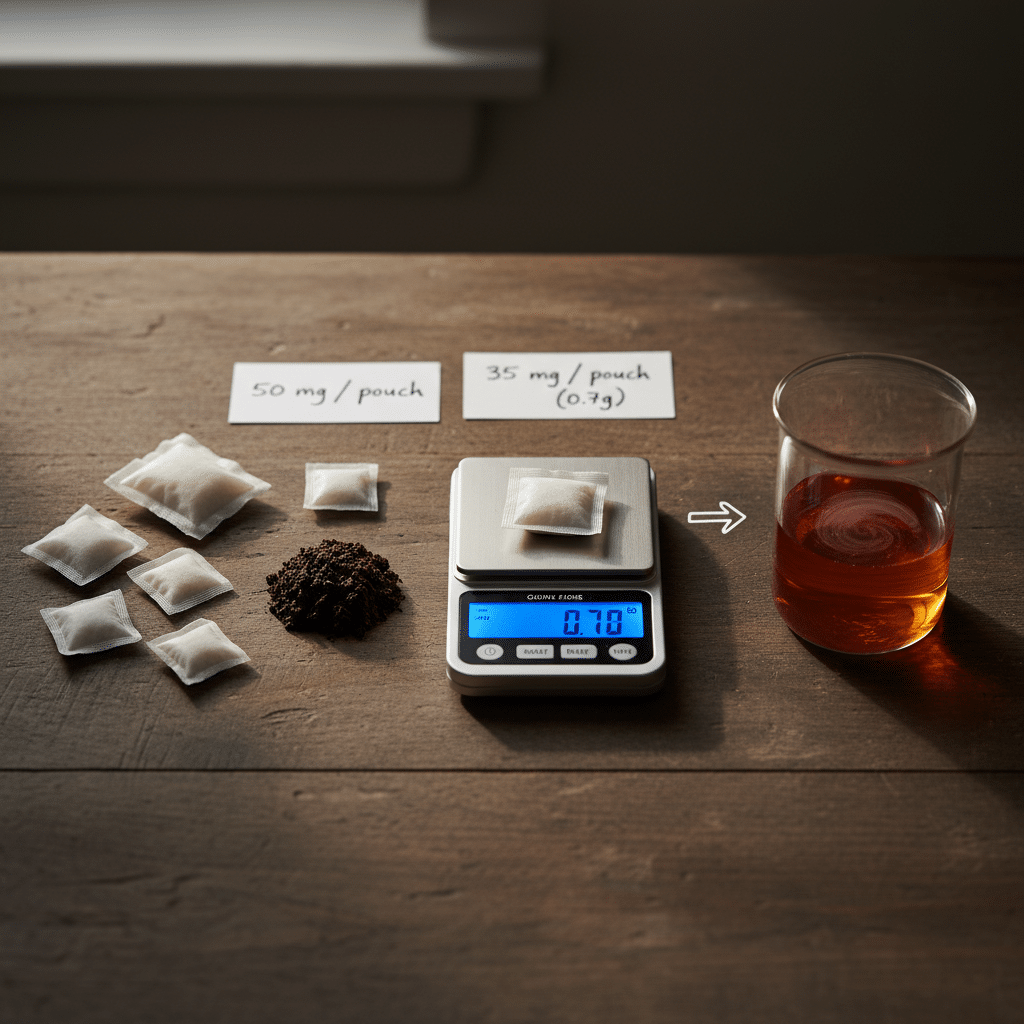
In many cases, the „50 mg“ refers to the nicotine content, but not always in the same reference system. Some manufacturers state mg per pouch (portion), others mg per gram of product. This sounds like splitting hairs, but in practice it makes a huge difference - especially if pouches are of different sizes.
If „50 mg“ is actually meant per pouch, this is a very high amount compared to normal portions. However, it is more common for a value such as „50 mg/g“ to be meant, i.e. 50 milligrams of nicotine per gram of snus. With a pouch weight of 0.7 g, for example, the theoretical total amount would then be closer to 35 mg per pouch.
It is important to note that even this „theoretical total amount“ is not the same as the amount that your body absorbs. It only describes how much nicotine is contained in the product - not what ends up in your blood.
mg per bag versus mg per gram
Many misunderstandings arise when comparing different brands or varieties. One strong snus may be stated as 50 mg/g by one manufacturer, while another advertises it as „20 mg/serving“. Without knowing the bag weight, such values can hardly be meaningfully compared.
Why manufacturer information is still helpful
Despite all the differences, the numbers help with orientation: they show whether you are in the low, medium or very high range. Especially for people who are sensitive to nicotine, this can protect them from making mistakes.
How does nicotine from snus enter the body?
Snus is not smoked, but absorbed through the oral mucosa. The nicotine diffuses through the tissue, enters small blood vessels and is distributed throughout the body via the bloodstream. Because no smoke is involved, some of the typical effects of inhalation are absent - but nicotine remains nicotine.
The intake often starts within a few minutes. Many people initially feel a slight tingling sensation or a „pinch“ where the pouch is located. After that, a clear nicotine effect can set in: Wakefulness, slight dizziness, faster pulse or even a queasy feeling in the stomach.
How quickly and how strongly it works depends greatly on how well the mucous membrane is supplied with blood, how moist the pouch becomes and how long it remains in the mouth. The pH value of the product also plays a role because it influences how well nicotine passes through membranes.
Oral mucosa is not the same as lungs
When smoked, nicotine enters the bloodstream extremely quickly via the lungs. With snus, the increase is usually more even and can last longer. This is exactly what makes the effect sometimes tricky: you only realise after a while that it was „too much“.
Why 50 mg is not the same as 50 mg intake
Even if a pouch actually contains 50 mg of nicotine, only part of it is absorbed. Some remains in the pouch, some is mixed with saliva and spit out or swallowed, and some is not completely dissolved in the mouth.
The bioavailability of oral nicotine products - i.e. the proportion that actually reaches the blood - varies considerably. The values fluctuate depending on the product, use and person. This is why the same snus can be „okay“ one day and have a surprisingly strong effect the next.
Time is also crucial. Someone who uses a very strong bag for 5 minutes typically takes less than someone who leaves it for 30-45 minutes. Many people underestimate that „I don't notice anything yet“ doesn't mean that nothing is happening - sometimes the peak simply comes later.
What happens to the nicotine swallowed
Swallowed nicotine is processed differently in the gastrointestinal tract than via the mucous membrane. Some is broken down, some can still be absorbed, but usually less efficiently. This is one reason why nausea can occur more quickly if you swallow a lot of saliva.
Which factors have a particularly strong influence on nicotine intake
Absorption depends not only on the product, but also on your body and the situation. People who are sober often feel nicotine more strongly. If you have just drunk coffee or are stressed, you may experience a different bodily reaction because your pulse and circulation are already „revved up“.
Oral health also plays a role: Minor injuries, irritated gums or inflammation can change the absorption and make the area more sensitive. Individual tolerance also plays a role: a regular nicotine user reacts differently to someone who only smokes occasionally.
Even small things like the position in the mouth (top vs. bottom) or how much saliva is produced can noticeably change the effect. There is no „one“ intake rate that applies to everyone - rather a spectrum.
Product design: moisture, salt, pH
Very moist products often release nicotine more quickly. pH optimisation can also increase absorption. This is why two pouches with similar mg specifications can feel completely different.
How does a very strong snus feel in everyday life?
With high levels of nicotine, many people initially report a clear „kick“: an alert head, focus, sometimes even a slight feeling of euphoria. This can be tempting, especially when you are tired or have to work long hours.
The downside often comes gradually: dizziness, cold sweats, palpitations or nausea. Some people experience trembling or an unpleasant feeling of pressure in the chest - not necessarily dangerous, but definitely a sign that it's too much.
Discretion also plays a role in everyday social life. Strong products can „run“ more strongly, i.e. cause more salivation. If you swallow a lot, you risk stomach problems more quickly. This is less a question of „hardness“ than of body chemistry.
Classification compared to other nicotine sources
Many people want to know how „50 mg snus“ compares to cigarettes or vapes. The comparison is difficult because the absorption speed and typical consumption patterns are different. A cigarette is gone quickly, a snus stays in the mouth for a long time.
In addition, nicotine is absorbed very efficiently and quickly when smoked, whereas it often rises more slowly with snus. This means that the maximum effect can come later, but may last longer - which is particularly relevant with very strong pouches.
As a rough guide, it helps to look not only at mg, but also at the subjective effect profile: How quickly do you feel something? How long does it last? And how well can you dose? With strong snus products, the dosage is often less precise because even „one pouch“ can be a lot.
Comparison table: What numbers can roughly mean
The following table is not a medical measurement, but a practical categorisation. It shows why the mere mg figure is not sufficient and which adjusting screws can increase or decrease the actual load.

| aspect | What it says on the pack | What it affects in practice |
|---|---|---|
| Reference value | mg/bag or mg/g | Comparability between brands, real amount of nicotine per serving |
| Bag weight | often not prominent | How much nicotine is in the pouch in total |
| Moisture | rarely as a number | How quickly nicotine is released (kick vs. slow build-up) |
| pH value | mostly not specified | How well nicotine is absorbed through the mucous membrane |
| Duration of application | Your decision | How much nicotine you actually ingest |
| Individual tolerance | is nowhere to be found | Whether it has a pleasant effect or quickly becomes too much |
If you want to compare figures, it helps to always look at the reference value and be aware of it: Two products with „50 mg“ can differ massively in reality.
Why some people hardly notice anything and others immediately overdose
That sounds unfair, but it's normal: people differ in their metabolism, circulatory response and nicotine habituation. People who use regularly build up a tolerance. This does not mean that it is „healthy“ - only that the noticeable effects shift.
Body weight and general state of health also play a role. Someone with a low body weight or sensitive circulation can react more strongly. And then there is the daily form: lack of sleep, stress, little food - all of these can suddenly make a strong pouch much more severe.
Another point is expectation. People who are afraid of the „50 mg“ label pay more attention to body signals and interpret them more intensively. Conversely, someone who „can take it“ can ignore warning signs for too long.
Tolerance is not a protective shield
Even with a high tolerance, a very strong product can trigger side effects, especially if several pouches are used in succession. The body can only break down nicotine at a certain rate.
Risk moments in which 50 mg can become particularly problematic
There are situations in which very nicotine-rich products „tip over“ more quickly. Sobering up in the morning is a classic: the circulation is not yet stable and nicotine can come as a hard blow. Even after sport, when blood circulation is high, the intake can feel stronger.
Alcohol is also an issue. Some people combine the two because it's socially acceptable. The catch: alcohol lowers inhibitions and changes body perception. You realise too late that the bag is too strong, or you immediately have another one.
And then there are medications or pre-existing health conditions that affect your pulse and blood pressure. If you know that you are sensitive to this, „extra strong“ is not the best place to experiment.
What helps with nausea, dizziness or palpitations
When it gets too much, the most important thing is to get the bag out. Sounds banal, but it's the crucial step. Afterwards, many people find it helpful to drink water and sit quietly. Fresh air can be pleasant, especially if you feel warm and nauseous.
Eating something - for example bread, banana or something savoury - can calm the stomach. Some people also react well to sugar, but this depends on the individual. It is important to give your body time: Nicotine breaks down, but not in two minutes.
If you experience severe discomfort, feel very light-headed, have chest pains or feel like you are about to collapse, it makes sense to get help. Especially if you are unsure, it is better to be too careful than too cool.
How to read product pages and shops more realistically
Online, people like to advertise with strength - „extra strong“, „ultra“, „50 mg“. This attracts attention, but does not tell you how the product behaves in the mouth. Reliable information would be: Nicotine specification with reference size, pouch weight, moisture level and ideally information on the target group (beginner vs. experienced).
When you're in the middle of your research, you'll inevitably stumble across offers. Sometimes a quick reality check helps: look for details, not superlatives. A product description that just screams „brutally strong“ says little about the actual usability in everyday life.
If you want to find out more or compare products, you can find such overviews in many shops; it is important not to just stare at the large mg value. If you are looking for Buy strong snus make sure that the information clearly distinguishes between mg/g and mg/bag and that portions and strengths are clearly explained.
How to better control the dose in everyday life
With very strong pouches, „controlling the can“ is less a question of willpower than of strategy. A simple adjustment is the time: leave it in for a shorter time, take conscious breaks and don't mindlessly „top up“ just because it's routine.
The position in the mouth can also help. Some people notice that there is less „running“ at the top, which keeps the stomach calmer. Others prefer the bottom because it feels more comfortable. It's not rocket science, but it can noticeably improve your everyday life.
If you notice that you regularly reach your limit with 50 mg products, this is not a character flaw - it is an indication that the strength may not suit your consumption style. Sometimes „going down a notch“ is not boring, but simply more relaxing.
Conscious timing instead of autopilot
Many overdoses don't happen on the first bag, but on the second or third because you're working, gambling or travelling on the side. A quick check-in („How do I feel right now?“) often prevents the moment when it tips over.
What you should know about habituation and addiction
Nicotine is addictive - this is not a moral judgement, but a sober description. Strong products can accelerate this spiral because the body gets used to high peaks. Then „normal“ suddenly seems weak and you automatically look for more.
Habituation not only manifests itself in strength, but also in timing: you reach for a pouch more quickly, become restless without nicotine or firmly associate certain situations with it. This can happen gradually, especially in everyday life, without you consciously planning it.
If you realise that you actually want less but are constantly adding to it, it's worth taking an honest look. It's perfectly okay to take the issue seriously - and it's also okay to get support if you want to get out of the pattern.
Frequently Asked Questions
How much nicotine do you really ingest with 50 mg of snus?
Usually significantly less than 50 mg, because some remains in the sachet and absorption via the oral mucosa varies from person to person. How much it is in the end depends heavily on the product, duration of use, pH/humidity and your tolerance.
Is 50 mg snus automatically dangerous?
Not automatically, but it is a very strong level and therefore easier to overdose, especially for beginners or if you are sober. Warning signs such as nausea, dizziness or palpitations should be taken seriously and the bag removed immediately.
Why does strong snus sometimes take effect later?
Because nicotine often enters the bloodstream more slowly and evenly via the oral mucosa than when smoking. The noticeable peak can be delayed, which leads to people topping up too early and taking in too much overall.
What should I do if snus makes me sick?
Take out the bag, drink water, sit down and breathe calmly. A little food can calm your stomach. If severe symptoms persist or you feel unsafe, get help or have it checked out by a doctor.